Decoding Microenvironment‐Driven Cell Fate: First Results from a Boolean Aging Model
- David Martinez, PhD.
- May 4
- 7 min read
Updated: May 4
Introduction
The Beyond Life project initially uses a Boolean network to simulate and represent key hallmarks of somatic cell aging. Each node can be ON or OFF and represents either an environmental signal (e.g. nutrients, growth factors, DNA damage, oxidative stress) or an intracellular pathway (e.g. PI3K/AKT/mTOR, AMPK/FOXO/sirtuin, ROS/DDR/p53). Cell‑fate outcomes—proliferation, senescence, apoptosis and SASP—arise from the logical interplay of these nodes. To explore the model’s behaviour, we simulated four biologically relevant microenvironments by fixing the environmental inputs and allowing the network to evolve from an initial state with all internal nodes OFF. The simulations reveal distinct attractors corresponding to youthful proliferation, chronic damage–induced apoptosis, oxidative stress–driven senescence, and severe stress–triggered apoptosis.
Simulation conditions
The four microenvironments are summarised below. In all cases the eight environmental inputs are fixed at the indicated values (True = ON, False = OFF) and all other nodes start OFF:
Condition | NUTRIENTS | GF | DNA_DAMAGE | ER_STRESS | INFLAM_ENV | HYPOXIA | MATRIX | OX_STRESS | Rationale |
Proliferative | True | True | False | False | False | False | True | False | Young, low‑stress microenvironment with ample nutrients, growth factors and matrix contact. |
Chronic Damage | True | True | True | True | True | False | True | True | Represents aging tissues: persistent DNA damage, oxidative and ER stress, and chronic inflammation. |
Senescence Entry | True | False | False | False | False | False | True | True | Lack of growth factors with oxidative stress encourages protective senescence. |
Apoptosis Trigger | False | False | True | True | False | True | False | True | Severe nutrient deprivation, DNA damage, ER stress and hypoxia push the cell to apoptosis. |
Results and attractor dynamics
Network Topology
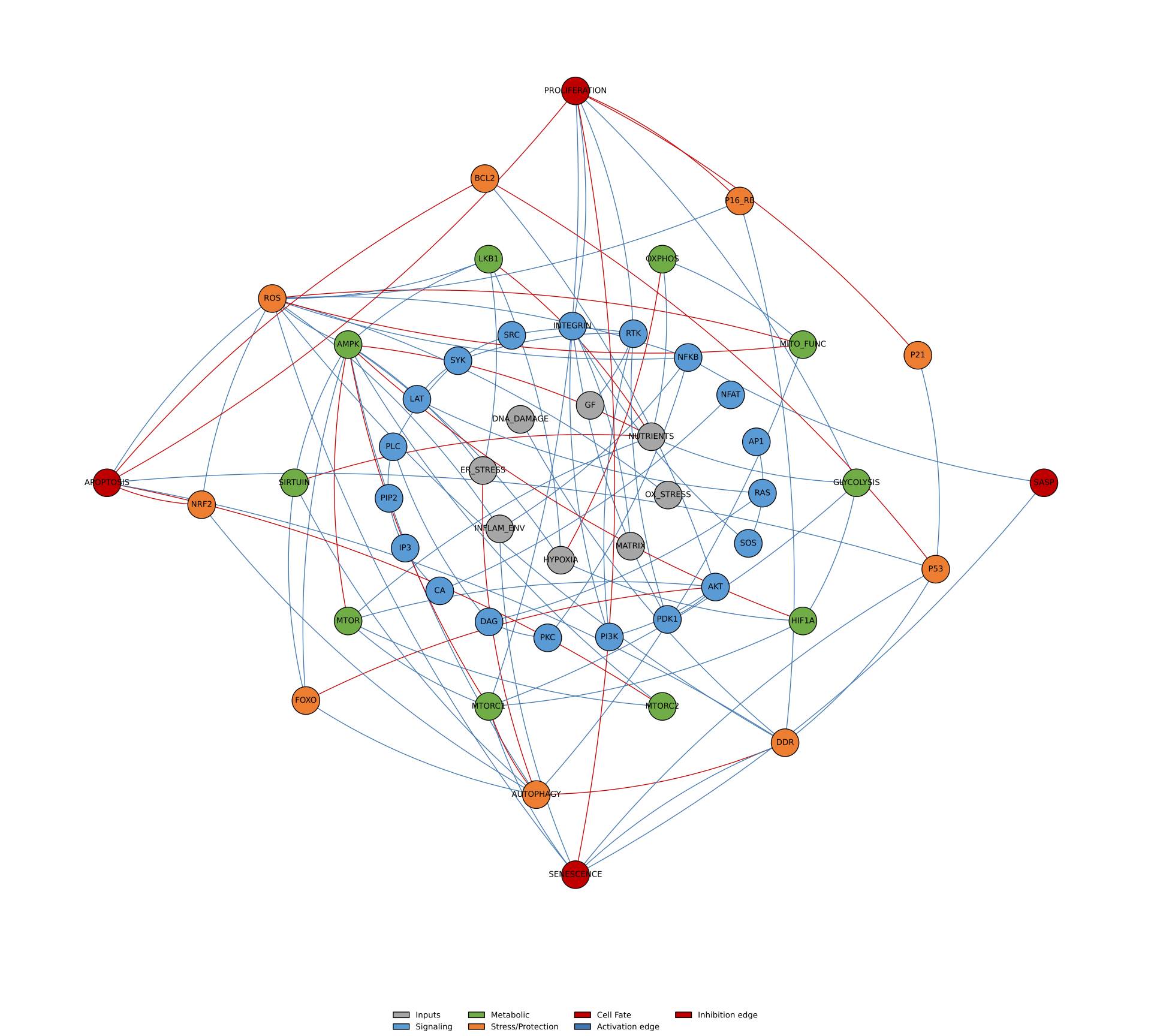
The somatic‑cell network is organized as a layered, directed graph that integrates external cues and internal stresses to decide between growth, senescence and apoptosis. Even though we removed the node names in the simplified topology figure, several important structural features remain visible.
Layered architecture
The network consists of five functional layers:
Inputs (grey nodes) represent environmental conditions—nutrients, growth factors, matrix contact and stressors.
Signalling nodes (blue) form classic pathways (RTK, integrin, PI3K/AKT, PLC/DAG/PKC and MAPK modules) that propagate the input signals downstream.
Metabolic/energetic nodes (green) such as LKB1, AMPK, mTOR and SIRTUIN control nutrient sensing and energy balance.
Stress/protection nodes (orange) like ROS, DDR, NRF2, FOXO and autophagy capture oxidative stress, DNA‑damage responses and protective programmes.
Cell‑fate outputs (red) determine whether the cell proliferates, enters senescence, undergoes apoptosis or secretes inflammatory SASP factors.
This stratified topology reflects what graph‑theoretic analyses have found in real signalling systems: feedback modules are arranged hierarchically and produce layered temporal profiles, while local and global feedbacks act on different aspects of information flow but work together to implement specific biological functions. Redundant channels and feedback controls create robustness, and reaction hubs at junctions of different paths are particularly important for regulating information flow.
Multiple signalling paths and cross‑talk
The network is not a single linear chain. It contains parallel pathways that fork and converge, especially within the signalling and metabolic layers. Such redundancy resembles the multiple signalling paths observed in biochemical networks, which provide extra robustness: removing one path may reduce a response but does not abolish it entirely because another path can compensate. In the mTOR/AKT axis, for example, growth-factor signals can reach mTORC1 via both PI3K and PDK1; AMPK can inhibit mTORC1 through several routes; and ROS can influence both metabolic and stress nodes. This web of cross‑talk ensures that a cell’s fate is not determined by a single cue but by integrated signals.
Feedback loops and hubs
The topology includes feedback loops that allow the network to adapt. For example, ROS activates NRF2 and FOXO, which in turn up‑regulate autophagy to reduce ROS, creating a negative feedback. Positive feedbacks also exist, such as SASP reinforcing inflammation via NFKB. In hierarchical decompositions of signalling networks, such global and local feedbacks modulate distinct features of the information flow and confer robustness. Nodes at the centre of multiple pathways, such as AKT, AMPK, mTOR and ROS, serve as hubs that collect signals from different modules; in real signalling networks, such hubs are often tightly regulated and critical for coordinating responses.
Biological interpretation
The overall topology mirrors how eukaryotic cells integrate their environment. Inputs feed into signalling pathways that couple to nutrient and stress sensors. These upstream modules interact extensively via cross‑talk and feedback, creating a robust yet flexible decision‑making apparatus. When growth signals dominate and stress is low, the network channels signals through AKT and mTORC1 towards a proliferative attractor. When stress signals such as ROS and DNA damage accumulate, signalling is diverted to stress‑response modules (AMPK, NRF2, DDR), and the balance of feedback loops pushes the network towards senescence or apoptosis. The layered, interconnected topology thus allows the same cell to switch between very different fates depending on the combined input from its microenvironment.
In short, the topology of your model is not just a random tangle of nodes—it reflects key design principles seen in biological signalling systems: hierarchical organisation, modular feedback loops, redundant pathways and hub nodes. These structural features underpin the dynamic behaviours you observed when you simulated different microenvironments.
Proliferative condition (youthful microenvironment)
In a healthy environment, the network quickly settles into a proliferative attractor. AKT, MTOR, MTORC1, GLYCOLYSIS and PROLIFERATION remain ON, while stress indicators such as ROS, DDR, P53, AMPK and AUTOPHAGY stay OFF. Mitochondrial function is maintained and there is no activation of protective checkpoints. Biologically, this represents a youthful tissue state where energy supply and growth signals predominate and the cell cycle proceeds. Research shows that mitochondrial respiration efficiency declines with age, increasing electron leakage and reducing ATP generation; therefore maintaining mitochondrial function in youthful tissues supports the proliferative state.

Chronic damage condition (aging microenvironment)
When DNA damage, ER stress, oxidative stress and inflammatory signals are all ON, the model experiences a surge in ROS and activates the DNA damage response (DDR). P53 turns ON, AMPK responds to energy stress, and MTORC1 remains OFF. Without adequate survival signalling from BCL‑2 or MTORC2, the network converges to a fixed attractor where APOPTOSIS is ON and all other fate nodes are OFF. This reflects the idea that severe, chronic damage triggers programmed cell death to remove irreparably damaged cells. Age‑related decline in autophagy and proteasome function, combined with mitochondrial dysfunction, can push cells toward apoptosis rather than repair.

Senescence entry condition (oxidative stress without growth factors)
In this scenario, oxidative stress is present but growth factors are absent. The trajectory shows rapid activation of ROS and AMPK, triggering FOXO and SIRTUIN signalling and inducing AUTOPHAGY. With AKT and MTORC1 OFF, the cell does not proliferate. Instead, the network stabilises in an attractor where SENESCENCE and SASP are ON, while PROLIFERATION and APOPTOSIS remain OFF. This captures the protective aspect of senescence: a damaged cell stops dividing but remains metabolically active and secretes cytokines. Inflammaging arises because senescent cells secrete pro‑inflammatory factors and NF‑κB is often activated. Senescence is thus a tumour‑suppressive fail‑safe mechanism, yet chronic accumulation of senescent cells and SASP can drive tissue ageing.

Apoptosis trigger condition (extreme stress)
Under severe nutrient deprivation, DNA damage, ER stress, hypoxia and oxidative stress, the network rapidly activates ROS, DDR and P53. AMPK and SIRTUIN turn ON but cannot rescue energy balance. MTORC1 remains OFF and AUTOPHAGY fails to activate. The system moves directly to an attractor where APOPTOSIS is ON. This mirrors biological situations such as ischemia or severe metabolic collapse, where cells cannot adapt and undergo programmed death.

Discussion and interpretation
These first simulations highlight how environmental conditions alter the attractor landscape of the somatic cell ageing model:
Growth vs stress balance. In the absence of stress inputs, growth signals (GF + nutrients + matrix) activate the PI3K/AKT/MTOR axis, leading to proliferation. When stress dominates, AMPK/sirtuin pathways override growth signals and P53 checkpoints engage. Genetic manipulations that reduce insulin/IGF‑1 signalling, AKT or mTOR activity extend lifespan in multiple species, consistent with the trade‑off observed here.
Role of mitochondrial and proteostasis health. Mitochondrial dysfunction and decreased bioenergetic efficiency are hallmarks of ageing. Reduced autophagy and proteasome function with age impair the clearance of damaged proteins and organelles, contributing to chronic ROS accumulation and pushing the network toward apoptosis. Interventions that induce autophagy, such as rapamycin or spermidine, extend lifespan in model organisms and could shift cells away from senescence or apoptosis in this model.
Senescence as a double‑edged sword. The senescence attractor demonstrates how oxidative stress without growth signals leads to cell‑cycle arrest and SASP secretion. Senescence prevents proliferation of damaged cells and is considered tumour‑suppressive. However, SASP factors contribute to inflammaging. Future model refinements could include feedback from SASP to the inflammatory environment.
System‑level perspective. The Boolean framework shows ageing as a shift in dynamic attractors rather than a linear decline. A youthful microenvironment supports a proliferative attractor, whereas chronic damage or extreme stress pushes the system into apoptosis or senescence. This systems view echoes the idea that multiple hallmarks of ageing interact and that effective interventions must target several pathways simultaneously.

Overall, these first results validate the model’s ability to reproduce biologically plausible cell‑fate decisions. They provide a conceptual map linking environmental cues to distinct attractors, offering a foundation for exploring how interventions—nutrient modulation, autophagy induction, inflammation control—might shift aged cells back toward healthier states.


Comments